Unified Dynamic Checkout reimagines how BNPL works at the moment of purchase.
Platform-scale Design System Transformation
Unifying Afterpay & Cash App into a multi-brand, scalable design system
Company
Cash App Afterpay
Timeline
2025
—
2025
Role
Product Design Lead
Project overview
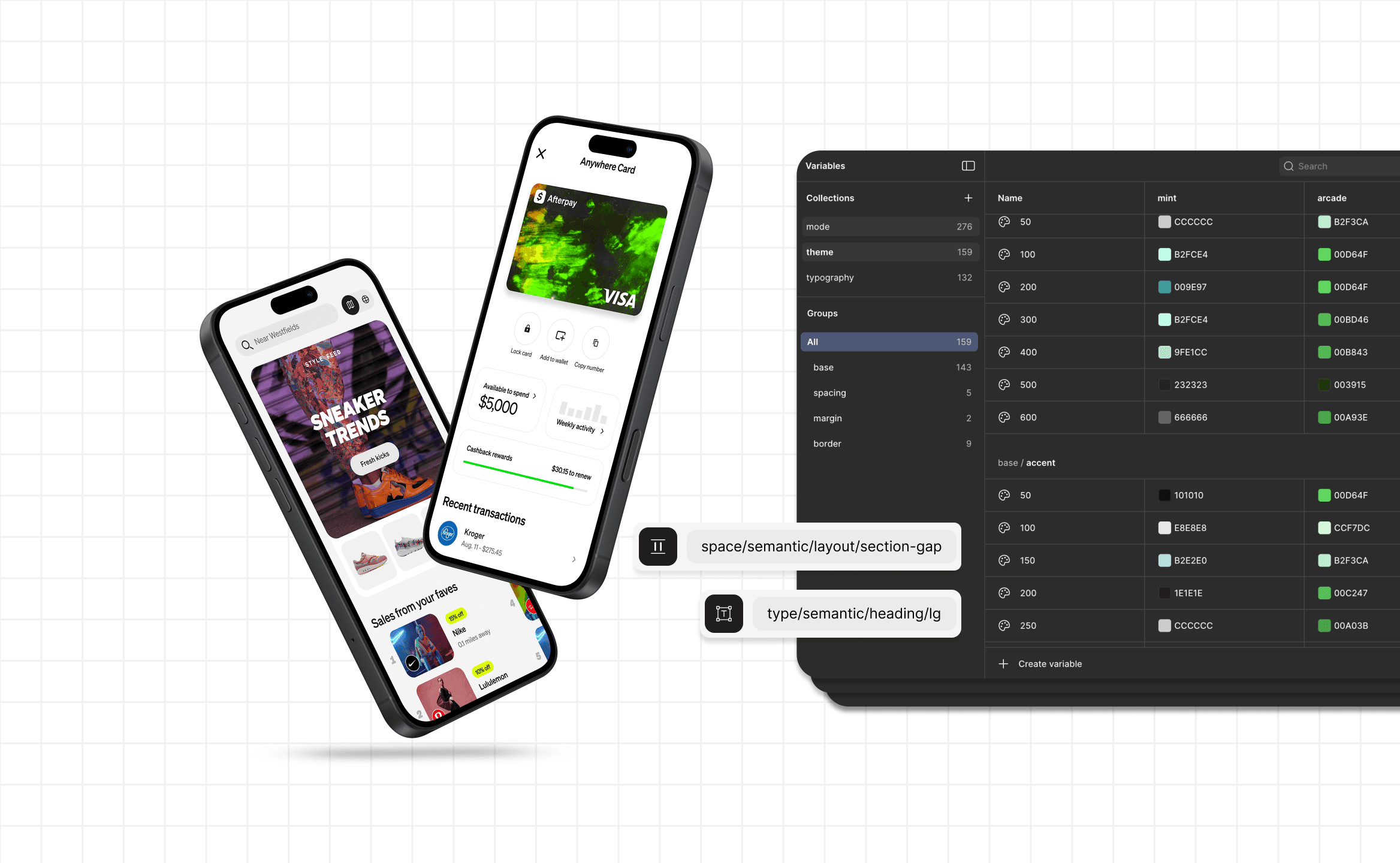
Afterpay and Cash App were operating as two distinct product ecosystems with divergent design systems, duplicated components, and inconsistent user experiences.
As Block moved toward a more integrated commerce platform, this fragmentation became a scaling constraint — slowing product development, increasing design and engineering overhead, and creating inconsistencies across global markets.
I led the design system transformation to unify both platforms into a single, scalable, multi-brand system — enabling teams to move faster while maintaining product quality and brand integrity.
Challenge & Opportunity
Two mature products with independent design systems
Significant component duplication and drift
No shared token architecture or theming model
Increasing complexity from multi-market expansion
Tight coupling between design and engineering implementations
Growing need for cross-product experiences
At scale, this created:
Slower delivery across teams
Inconsistent user experiences
High maintenance cost for design and engineering
Limited ability to ship platform-level features



Outcomes
Establish a single source of truth across Afterpay and Cash App
Introduce multi-brand theming to support distinct product identities
Decouple design decisions from implementation through tokenisation
Enable cross-platform product development
Create a system that scales with Block’s long-term platform vision

Unified Dynamic Checkout reimagines how BNPL works at the moment of purchase.
Platform-scale Design System Transformation
Unifying Afterpay & Cash App into a multi-brand, scalable design system
Company
Cash App Afterpay
Timeline
2025
—
2025
Role
Product Design Lead
Project overview
Afterpay and Cash App were operating as two distinct product ecosystems with divergent design systems, duplicated components, and inconsistent user experiences.
As Block moved toward a more integrated commerce platform, this fragmentation became a scaling constraint — slowing product development, increasing design and engineering overhead, and creating inconsistencies across global markets.
I led the design system transformation to unify both platforms into a single, scalable, multi-brand system — enabling teams to move faster while maintaining product quality and brand integrity.
Challenge & Opportunity
Two mature products with independent design systems
Significant component duplication and drift
No shared token architecture or theming model
Increasing complexity from multi-market expansion
Tight coupling between design and engineering implementations
Growing need for cross-product experiences
At scale, this created:
Slower delivery across teams
Inconsistent user experiences
High maintenance cost for design and engineering
Limited ability to ship platform-level features
Outcomes
Establish a single source of truth across Afterpay and Cash App
Introduce multi-brand theming to support distinct product identities
Decouple design decisions from implementation through tokenisation
Enable cross-platform product development
Create a system that scales with Block’s long-term platform vision